
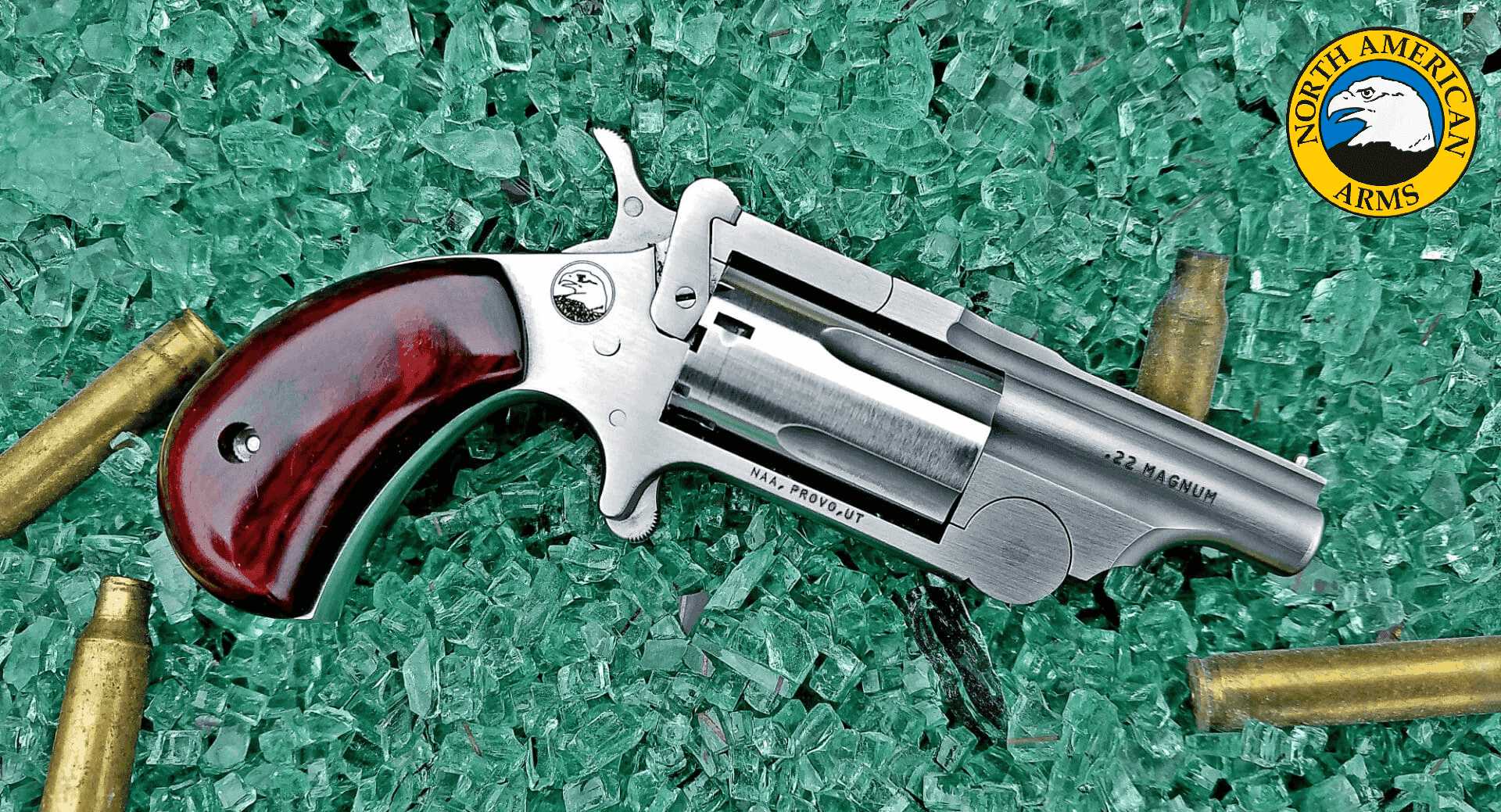
The North American Arms is known for their mini revolvers.
They’re out of Provo, Utah. They’ve been in business since 1974. And these are, to me, one of the ultimate mouse guns.
They’re just tiny. They fit in your pocket to where you don’t even know it’s there. And the quality is really nice.
The one downside to the mini revolver is loading and unloading. You have to actually remove the cylinder. But today we’re going to take a look at their Ranger II.
It’s still a five-shot, all-stainless steel, high-quality revolver, but hit this latch, open it up, and you can reload it really quickly. And then it comes in .22 and .22 Magnum, and you can get the conversion cylinders. This is one of those little guns that you can, again, it just disappears.
And yet, if you need it, it’s right there. In fact, I have a good friend of mine who is U.S. Marshal, and he said he carries one as his get-off-me gun. These are great little revolvers.
I’ve been a big fan for a number of years. And so we’re going to take a look at the Ranger II. We’re also going to take a look at the Pug, which is more their traditional line.
And we have a Sidewinder and some other options. And just talk about the mini revolvers, but to me, the Ranger II really kind of changes the game because it makes it so fast to load and unload. And plus, they’re just a lot of fun.
And a big thank you to North American Arms for sending the Ranger II mini revolver for this review. Guys, if you watch the channel, you know I’m a big fan of mouse guns. And this, to me, is the ultimate in mouse guns.
They are tiny. And these are the mini revolvers. We have the North American Arms revolvers here.
We have the Freedom Arms little .22. Now, this, again, is what kind of started it all. One of the things that I think North American did was bring some extra quality and just ease of use. This is a very small, tiny little revolver.
Now, I do have this in .22 long rifle with the North American Arms. It’s just put away in one of my safes. I couldn’t find it.
But pretty much the same shape, but definitely some upgrades. And with this one, you unscrew the cylinder pin, and then you can bring out the cylinder. So it’s a little slower to load as well.
And then we have the switch gun. And this is from Standard Manufacturing. It’s pretty cool.
It has a little catch here. And when you hit it, it pops it out. And now you’re ready to fire.
When it’s closed, it blocks the trigger from firing. So it gives it a kind of a beefy feel to it. This is in .22 Magnum.
And you pull down, pull out, and then the cylinder comes out. And that’s the way most of your North American Arms revolvers operate. Just pull it out, pull the pin out, and then the cylinder comes out.
With this one, you push forward, and it just closes. This is a really cool way to keep this in your pocket. It’s a little beefier though than the North American Arms.
We have the pug, which is also that pull-out cylinder. And so it comes out. And honestly, this is the slowest to load.
It’s one of the downsides to your North American Arms revolvers, is that it takes a little extra time. And then we’re going to put our cylinder in. You have to line it up.
And I like to put it kind of on a half cock and just adjust it. And again, it’s just one of those things that takes a little bit more time. But you do have five shots of .22 Magnum, or there are a lot of models that are .22. And they have some .22 short models.
And so this one is the traditional model. Then they came out with the Sidewinder. And this is an easier loading little single action revolver.
So I make sure it’s on half cock. I pull it forward, and then we just push it out. And it’s more like a double action revolver.
The cylinder swings out. So it has that swing out cylinder. And we have a star crane ejector.
So we just push on the ejector rod, and we can pop those rounds out a lot easier. With the original, there is no star ejector rod. So you have to pull them out.
And typically, they’ll drop out. But this is, to me, a much faster loading system. And then you just bring it and close it.
And so you can load it, unload it fairly quickly, compared to trying to fish around with the pin that goes in the cylinder. But this is one that I’ve really wanted to check out for a good while. And that is the Top Brake, which is the Ranger II.
This comes in a number of different barrel lengths, as well as all of these. Up to a four inch barrel length, all the way down to a 1 5 8 inch barrel length, which this is the 1 5 8 inch. And they come in some different finishes.
Now the Ranger II only comes in this brushed stainless steel. But you can see, I mean, it is very well machined. It’s a beautiful little firearm.
And they’ve gone away with the Top Brakes in a lot of your modern revolvers. But with this being 22 or 22 Magnum, makes it really simple just to pull it, open it. And when you do, it takes that star ejector, and it ejects the rounds.
So that’s very simple. Load it, close it, and you’re ready to fire. This is the fastest of the bunch.
Now this one does come with a 22 Long Rifle conversion cylinder. And you can get this model with just 22 Magnum. And all of these, the same thing.
They have the conversion cylinders that go with them on the North American Arms. And we have the Rosewood grips, which are really nice. But you can get the Pebble rubberized grips.
And this is the oversized grip. Then has the standard grip. One of the things I do like about the Pug is that it has better sights.
So we have a little sight at the back that’s raised. It’s actually dovetailed in. And then we have a tritium bead at the front.
You have this ribbing. And this makes a great gun to be able to slip in your pocket. Again, I’ve been carrying this one for a good while.
And I love it. I mean, it’s five shots, and it’s a backup. And you don’t even know it’s in your pocket.
But the Sidewinder is the same thing. And they have multiple color grips. They have a number of different things right there on the North American Arms site.
So you can check that out. Now with the Ranger II, this is actually the NAA-22MCR. And that’s the one that comes with the conversion kit or the conversion cylinder.
And you can get it with just 22 Magnum. So this gives you really a lot of power with 22 Magnum. But with this shorter barrel, there’s only so much you’re going to get with the advantage of 22 Magnum, except that it’s going to have a lot more sound, and it’s going to have a lot more flash.
And I really like that. I mean, why not carry 22 Magnum when it’s about the same size? The hammer is single action, so you have to pull the hammer back. And then we have this little unguarded trigger.
And it’s serrated. And you just pull it, and it fires. Now, I don’t like to fire on an empty cylinder with rimfire.
And we’re going to test out some trigger pull, because I do have some snap caps. But the fit and finish of these little revolvers is just excellent. I mean, it’s very well done.
These have been around again since 1974 with North American Arms. And to me, they make really high quality little firearms. One of the things, though, about these small revolvers is the parts inside are very small.
And so that could lead to maybe some issues if you shoot this a lot. And really, it’s a lot of fun to take to the range and shoot. I mean, it’s almost a novelty, but yet it makes a great self-defense tool.
And it’s very small in your pocket. So when you can’t carry anything else, this little North American Arms can fit in your pocket, and nobody knows it’s there. We do have a fluted cylinder, and we have the latches, plus we have this little lock.
And one of the things about this is that when you bring this around and you set it halfway, it’ll actually lock into the cylinder. And so that way, once you pull it back, then it goes back into place. But what that does, it offsets the hammer and the firing pin to your cylinder.
So it makes it drop safe. And so this is one thing you really need to take note of, is to go ahead and put it in that small little latch to be able to hold this into place. And that gives you your safety.
Then you can just turn it. Extremely good lockup. I mean, everything is locked down solid.
And of course, with the top break actions, those kind of went away after the late 1800s. But with .22 and .22 Magnum, you’re safe, and there’s not a lot of pressures. And so this is definitely a viable option.
And again, it is the fastest loading. Now, you do have your brushed stainless finish, and then it has more of a matte finish toward the barrel. But this is a 1.63 inch or 1.58 inch barrel, so it’s really short.
But you can get up to a 4 inch barrel with these models, and I believe a 2.5 inch model. But to me, when you start getting to 4 inch, it starts to get large. And the huge appeal of these firearms is that they’re so small.
Now it does have a small little bead front sight, and then you just have this little notch here at the back. Now I’m going to tell you guys, it took me a while to get the accuracy, and we’ll look at it. But I ended up getting a really nice group at about 5 yards.
It wasn’t that far out, but this is what a friend of mine, who is U.S. Marshal, he carries one of these, and he calls it his get-off-me gun. It’s not the Ranger II, it’s one of the original, I believe it’s the Pug. But he really likes to have that handy.
But you can see how the finish is just very well mated all the way around. And with that matte finish, you’re going to pick up any kind of defects, and there’s just not any. Now this one has .22 Magnum on the barrel, even though you can put that .22 Long Rifle cylinder.
Now I have the .22 Long Rifle cylinder installed. This is the .22 Magnum. But I’m going to show you how easy it is to change these cylinders out.
So first you just want to break it open, and then right here, this latch holds your cylinder in. So just push up, and the cylinder comes right out. And then we can take our next cylinder, just put it in the tube, and then lift up, and it closes right in.
Very simple to do. Snap it, and this is spring-loaded, and it just locks the top. I mean, that is so easy.
Now with the .22 Long Rifle, it’ll have an L on the cylinder. Now this one’s pretty dirty because we were shooting it. But that is the way you can tell the difference between the Magnum.
It has no markings. But the .22 Long Rifle does have the small L. And you can look at the cylinder. I mean, the fluting, the notches, everything is crisp and very well executed.
And when I say crisp, the edges can be a little sharp. But this is so small and so easy that it actually gives you something to hold onto. And then you can see the rod that comes through.
And again, that’s your star ejector. And it just pops those rounds out. Again, with the pug, it makes it a little more difficult because there is no star ejector, so you have to just pop the rounds out.
But, and after shooting it quite a bit, they can get a little stuck. These seem to do pretty good. They were a little slow at some times when I was popping them out, not coming out of the cylinder, but actually coming up, and then they would kind of hold, and you just pop them out.
But this still makes it a very fast reload for your mini revolver series. And we have the North American Arms logo right here on the side. Again, these are made in Provo, Utah, and we have it marked right here.
And typically you’ll find these as NAA for North American Arms. And then we have our serial number here at the bottom. Now I’ve installed the .22 long rifle cylinder because we’re going to check the trigger pull.
And I wanted to bring in some snap caps, and I have some .22 long rifle snap caps. So we’re going to put these in. Now the cylinder rotates clockwise.
So when you pull the hammer back, just to take a note. So we’re going to bring this down, lock it in. Now when we bring the hammer back, then you can pull the trigger.
And again, it is a small little nub. And then it fires. Now the hammer has the firing pin attached.
And of course this is rimfire, so it is off to the side, and it hits the rim of the cartridge. But not a lot of pressure. But when you are at the range and you’re really training, and you need to shoot this quite a bit if you’re going to carry this for self-defense.
That trigger is a little bit funny, and you want to make sure you know the trigger. And then you can really get decent accuracy. We’re going to check the trigger pull weight with our Lyman trigger gauge and brownails.
It’s a little difficult to get this trigger pull action. Really this is honestly made for the finger to be able to hit those serrations. Three pounds, 14.7 ounces.
With the roller here, and these small serrations, it’s very difficult to get. So not a bad trigger pull weight. But I want us to look at how this trigger functions.
So again, single action, you have to pull the hammer back. It brings the trigger out. And then as we pull it, it fires.
Now because it has a little bit of weight right to the beginning, you have to really hold it steady. And again, once you learn how to shoot this trigger, it will do very well. If you don’t, it shoots a little bit to the left.
And it shoots sporadic. So you want to make sure that you get that trigger pull and you are very consistent with it. But I’ll be honest, at close ranges, it doesn’t really matter.
You’re going to be on target if you get that up close. But again, at five yards, we got a really great group once we understood how the trigger functioned. This gives you a little closer look here at the latch.
Pull that back, open it up, and we’re going to lift it on up and it’ll just push out those shells. So it makes it really easy to get to or you can just dump them out. And then we bring it back.
It’ll just snap into place. Now you can see this trigger, the ribs on it. And it’s just that little section.
Of course, we don’t have it cocked yet. But we bring it back. There’s a little rib that runs down through it.
And then it just releases it. I think one of the things too about having a conversion kit is it gives you a lot of options. Of course, you can go with your .22 Magnum, which has more power, it has more velocity, typically a little heavier bullet.
And then we have your .22 Long Rifle, which is a little softer on recoil, which again, the recoil is not bad at all. And then we can go with shot shells. And so this gives you something for snake shot, rat shot, whatever, and you’ve got that option.
And you can fire all five rounds. So this gives you a number of different options. Plus, there are a lot of different .22 Long Rifle and .22 Magnum options out there.
And even the punch, which gives you a little more self-defense. So having something like this gives you just a different variety of ammunition. Guys, a big thank you to Fiocchi for sponsoring our ammo.
All made in the USA, one of the biggest suppliers of ammunition in the country. And we’ve got some .22 Magnum. This is the Field Dynamics.
And then we have some standard velocity .22 Long Rifle. And so we’re going to test out both. And again, we have both cylinders ready to go.
Now we just take it, pull down on that top latch, and then we can just open it right up. This is so much easier than the standard as far as speed. Being able to load these with the others, and we’ve shown that.
They’re just different ways. And it’s really cool that North American Arms is still innovating. And then we just take it, once you get these flat, and just bring it over.
There we go. So very easy to load. And the cool thing is you can change those cylinders just by lifting up here.
And then you just bring the cylinder right out. Now this is your .22 Magnum cylinder. Here we have our .22 Long Rifle.
There is an L marked on the chamber. So we just take it. It goes into this rod right here.
So we just bring it down, lift up on the top of the spine, and then just close it up. And then this just locks it in. And of course the .22, you just load it up.
Again guys, this is so much easier than pulling the cylinder out, or even with the sidewinder, which I really like. And just close it up, and it locks up. And it’ll just spring forward.
Alright guys, North American Arms makes many revolvers. I love their different styles. This is the Ranger Top Brake II.
This is to me the fastest to reload or load. So here we just have a little top brake action. It comes up.
The ejector just pushes out your shells. You know, traditionally with North American Arms, many revolvers, you pull the whole cylinder out. It’s a little bit of a process.
And then they have the sidewinder, which actually just drops the cylinder out like a standard revolver. But this, to me, is probably the fastest because it just comes right up. Now we have .22 Long Rifle in here, but just to show you how easy you just lift up and you pull the cylinder right out, we can go to .22 Magnum.
So it goes right in. It just locks in. Close it up, and we’re ready to fire.
It is single action, so I like to take my non-shooting hand, my thumb, and bring back the hammer. No recoil. I mean, none.
I mean, it’s so easy to shoot. And then when you want to go ahead and empty it, just bring it up, and it’ll bring those shells up. And then you can just toss them out, and they come out.
Sometimes they get a little stuck on the ejector, but otherwise, it’s real simple to do. Now, we’re going to take this out, lift up on that little top latch, pull it out. Now we have .22 Magnum.
So simple to change. And you just get it started. Once you get it in, close it, it just locks right down.
And so it’s ready to fire. Now, the .22 Magnum has a little more of a, just the muzzle rise. But honestly, there’s not a lot of recoil.
It’s still very comfortable to shoot. This tiny grip, though, makes it a little bit more difficult just to kind of grip to it. The bigger your hands, probably the more you’re going to have a little issue.
But honestly, it is very simple to shoot. And again, with .22 Magnum, we’re just going to pull it. We’re going to open it up.
Again, that ejector rod pushes them out. Then when you drop them out, now with .22 Magnum, the pressures are a little greater, so it takes a little more, but they come out pretty good as well. So let’s go ahead and just bring this out.
We’re going to shoot another round with one hand. So here we are, get our cylinder in, lock it into place. One hand shooting.
So easy to shoot. Now that was .22 long rifle, so it made it even simpler. But again, pop it out, drop out your rounds, and you’re ready to reload.
You can load those right in, have them in your pocket, and then you’re ready to go again. This is one of those guns, though, that I like just to have in my pocket as a backup. It’s not really my primary, so it just goes in my pocket in a small pocket holster.
So easy to carry, you don’t even know it’s there. The wood grips, there are some grips that are rubberized grips. They have a lot of options from North American Arms.
You know, guys, I’m just a big fan. I love these. They’re very well made.
They’re stainless steel, and they’ve been popular for years and years. So I really like the Ranger Top Brick, too, though. I think it’s probably the fastest to reload.
That’s not bad. That’s not bad. And when it comes to cleaning and maintaining your firearm, it makes it nice to be able to have that cylinder come all the way out.
You can keep this area clean. Of course, the front of your cylinder, you know, you can brush that down. One thing you don’t want to do is put a lot of lubrication on your ejector rod.
You want to clean it, you want to wipe it down, but it gets gummed up if you start to put lubrication. And then, of course, with this, as far as cleaning, you know, you just lift it up. Again, you can pull that cylinder right off, and then you can actually clean it from the chamber instead of from the front.
And so this area right here, just keep it clean. Keep this top strap clean, and then just the debris out of here. So it’s really simple to maintain and clean, and you want to lube your little catches to make sure that they’re in good working order, because all of these do have a little bit of give to be able to operate the firearm.
And it’s very simple to change this out, and these cylinders, it makes it really easy. You just want to make sure you lift up, and really, you don’t even have to do that. It’ll actually just force this up just a touch, bring it down, and we’re locked in.
So keeping it maintained is going to be very important with a very small firearm, and one thing that can be a problem is if you keep this in your pocket, even in a pocket holster, it can get lint and actually dead skin and things, and I find that a lot of times on my standard concealed carry. So with a smaller action, it’s going to be more susceptible to malfunctions if you don’t keep it somewhat clean and lubricated. Now, keeping your firearms maintained and cleaned is vital.
Otis makes some of the best cleaning equipment out there. They make a number of different kits that are dedicated for different rifles, pistols. They also have Shooter’s Choice, which makes excellent CLP and bore solvent and different cleaning materials.
The Ripcord is one of their signatures, and there’s a whole system based around it. They are suppliers to the U.S. military. So check out Otis Technologies, highly recommended, and we want to thank Otis for being a sponsor of the channel.
Now it does come in a North American Arms box, but what I love is this little case. We have a powder coat finish, it is lockable, and there is a hole here at the back that comes through where you can actually secure this if you want to put it somewhere. You can actually mount this in your vehicle, you can mount it somewhere in your house, and it just keeps it safe.
And then again, you have this little area to put a cable. So you can put this in a car. I mean, I have a Jeep, and a lot of times they get broken into, so this gives you a lock down.
And it does have the North American Arms logo. It comes with two keys, and we can open it up. It’s foam padded, has padding at the top.
You can see the little lock, and it just makes it a really nice package to be able to have this all together and to keep it secure. Here in the bottom, we have our owner’s manual, and you can see some of the models right here. I mean, they have a ton of different options.
And of course, this just gives you just some information about the gun itself. And you get 20% off accessories when you just go to their website. And again, there’s holsters, there’s grips, there’s hats, there’s all kind of different things.
I mean, they really have a lot of support around it. As far as price, their original models, just the standard models, start out at $255 retail. And of course, dealer price can be less.
There are prices all over as far as different barrel lengths, if you get the conversion kits. The Ranger II runs $535 with just the .22 Magnum. And then if you get the conversion, it’s $679.
So having the top break causes a little bit more manufacturing, and so there’s definitely a little bit of a price difference. The Pug starts out at $390 and ends up being $430 with the conversion. And again, those are retail prices.
A lot of times when you go into your gun shop, the prices are considerably less. Now, what are some pros and cons? First off, it is tiny. That’s a huge pro.
It can slip in your pocket. You never even know it’s there. It makes it very simple.
And there’s a lot of holster options. This is an Uncle Mike’s, and it’s a sticky pocket holster. It just fits in there extremely well.
You don’t know it’s there. It’ll catch when you pull it out of your pocket. But again, different grips, different barrel lengths.
While most of the models have the stainless steel finish, there are some models that have black and even green. And I believe those are more toward your Black Widow models. But a ton of different options.
Again, with the .22 cylinder, it just gives you another layer and definitely a lot cheaper to shoot even than your .22 Magnum. But the one big plus for the Ranger II is its top break. And so we just pull back, fast to reload, has that star ejector that just pushes them out, and you’re ready to go again.
And this is the fastest of the bunch. So to me, one of the downsides with these revolvers has been the loading. You might as well forget it.
You have to reload. It’s just gonna take too long. And then you have rounds in your pocket.
I mean, you know, this really makes a great option. It makes it really fast to be able to change that out. As far as the action and the recoil, it’s very mild, very easy to shoot, even in .22 Magnum.
It’s a little bit of muzzle flip, but you get a good grip on it, and it does very well. And even with these rosewood grips compared to some of the oversized grips like on the Pug or just standard rubberized grips that are on the Sidewinder. And these really help.
I mean, this gives you a good solid grip to the little revolver, but the rosewood grips are very comfortable. The hammer is spurred, and because it’s single action, that makes it nice. I like the sights.
It’s just a little bit of a cut here, and then we have a front bead, and this works out very well. And again, we saw with the accuracy, I mean, it is capable of good accuracy once you learn how to use that trigger. Now, I will say the trigger is a little bit finicky at times.
Only, though, I found when I was shooting with one hand, and it was just the way I had it gripped. I did it again. It did fine.
So really getting a full grip and a pad on this little trigger is going to be really what’s important. And so getting that little solid grip, and really that is part of a safety feature as well. The fit and finish is absolutely beautiful.
Some of the smaller parts that are in here, you could have some issues, but honestly, I’ve never had any problems with these little revolvers. And if you do, you have North American Arms that can either replace them or send you replacement parts. I mean, it’s slow because it’s a single-action revolver.
And yes, it’s faster to load, but still slower than a lot of other firearms. But this, to me, with five rounds of .22 Magnum or of .22, gives you an excellent self-defense option in your pocket. The price on the standard model at $255 retail, I mean, that’s very reasonable.
If you want to up your game to go to some of the higher models, then, you know, they can get a little bit expensive. But with the craftsmanship and the way these are made, I really feel like that it’s worth it. But again, that’s for you to decide.
And really, these are the three models, as far as loading, that are different. Of course, pulling the cylinder out here, having a swing-out cylinder here, these are just different options. And that’s one of the cool things about North American Arms is they have a lot of different models.
One thing that I failed to mention is they have their series, which is a semi-automatic. They start out in .25 ACP, .32 ACP, and .380 ACP. And they have made their own proprietary caliber, which is .32 NAA.
And these really compete with the C-CAMP, which is an excellent handgun in itself. So guys, when it comes to concealed carry, having a small little tiny revolver in your pocket that you don’t even know it’s there, it makes a great backup. It could make a primary, especially if there are just no options to carry, and you can slip this in your pocket.
And then with the Ranger II, making it so easy to bring that up and to reload or unload, and then you’re back in the fight. Or you just want to take it to the range and have some fun, because these are great little, high-quality revolvers. And again, a big thank you to North American Arms for sending the Ranger II Mini Revolver for this review.