
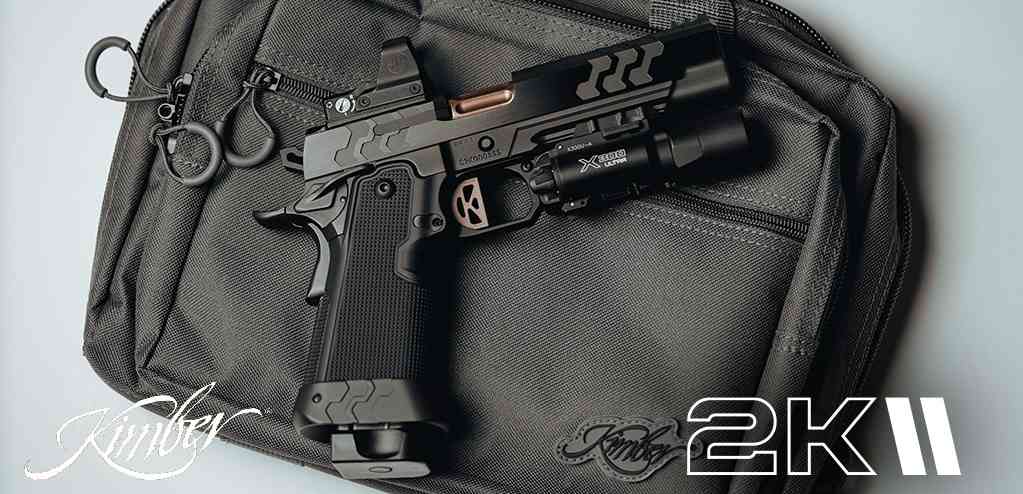
The Kimber 2K11, let’s check it out.
Kimber has released their 2K11, and this is their answer to the double stack 1911s or 2011 style pistols. But there are a couple of big differences.
First off, it has an aluminum grip frame, and this is extremely well made. There’s something about an all metal gun, and a lot of people are going back to that design. But also, it’s in .45 ACP, which is the traditional caliber for the 1911.
1911s served the U.S. military from 1911 to 1985, and this has been one of those legendary firearms. But yet, we have a much higher round capacity. And so you have all the controls of the 1911, but then you have 13 plus 1, a .45, ready to go.
And Kimber is known for its beautiful finishes. In fact, if I have a number of different 1911s out on a table, the Kimber always draws my eye. There’s just something about the way they do the finishing and the design.
So we’re going to take a look at all the details, and we want to give a big thank you to Kimber USA for sending the 2K11 for this review. The Kimber K211. This is a double stack 1911 in the 2011 style.
We’ve seen a number of different companies that have been introducing the 2011 style pistols. And guys, it’s great to see because the Staccatos, the STIs, they’ve really been out of the price range of most people. But this is allowing for a lot of different competitors to come in and just to offer really a lot of cool features for a lot less money.
Now again, there are a couple of differences with this 2011 style, and one of them is the aluminum group shell. We have texturing all the way around it. We have a cut here to be able to get your hand up high next to the grip.
The texturing goes all the way through the grip panels. The mainspring housing is also aluminum, and it is textured, and then the front strap. So it gives you a really nice grip, and then you have this smooth area underneath your trigger guard to be able to get a good, solid, firm handhold on this handgun.
Now in .45 ACP, which is something also that we’re not seeing a lot of, mainly with the 2011s, we’re seeing 9mm. But this gives you that classic .45 ACP, and we have 13 plus 1 in the magazine. Now this is a checkmate mag, and so they’re fairly reasonable.
We also have a nice base plate on here that’s pretty large, and we have these divots to be able to rip this mag out if we need to. And of course, during mag changes, that’s a big plus. But here we have a nice mag well in the aluminum housing, and this allows those magazines to go in extremely well.
In fact, you’ve got to actually mean to miss it almost, which is nice with your basic 1911s. It’s pretty much straight walled, and so this gives you that ability to get those mags in. But with the Target model, it has a custom Stan Chin magazine well.
So it’s actually an additional mag well. This one’s built into the frame. Now when I first got it, I thought the slide was blued, that hot salt bluing.
But this is actually a DLC coating that’s been brushed, so it doesn’t have that really shiny look to it. It has more of a matte finish, but yet it has a sheen. That’s going to give it a really durable finish.
This is going to resist scratches, and of course, it’s going to be rust resistant, and yet give you that classic look. Those serrations are absolutely beautiful, and the finish is beautiful. And then with the frame, this is all steel as well.
We have a three-slot Picatinny rail, and the frame here goes all the way back, but yet the aluminum comes up and attaches to it, which is, again, typical for your 2011-style pistols, except that they’re usually polymer. Now I like polymer. I carry a lot of times polymer handguns, but I’ve been going back to the all-metal frames.
I like the all-metal guns. They just seem to have some rigidity to them that the polymer frames don’t. Now that’s just my personal opinion.
I still really like a number of these in the polymer frame, but I thought this was a nice addition. Now Kimber decided to go with the aluminum because it was just a little more expensive, but not a lot. And so they wanted to really do something different where people are going, again, to that metal gun, and so that just gave them a really nice option.
And it does have a Type 3 hard coat anodized finish on it, so the finish is going to last very well. Now one area that steps away from the traditional 1911 is the extractor, and it is on the outside of the frame instead of back here at the back. And this just aids, honestly, in reliability.
And SIG also uses that external extractor. But when it comes to the guide rod, this is designed very well. It is a one-piece, and it is tool-less in disassembly.
So you don’t have a little pin you have to put down into a hole. This just allows you to just take this off directly. Now as far as the frame-to-slide fit, extremely tight.
Barrel-to-slide. No movement. I mean, everything is symmetrical.
It looks beautiful. Here on the back, there is no movement whatsoever. This is very tight.
And one of the things about having a really tight 1911 is it can affect reliability. If it’s too loose, it affects accuracy. So it’s really nice to have a good balance.
But again, when we were at the range, we shot over 500 rounds without one malfunction. I mean, it just flows. A lot of that has to do with the DLC coating with both the frame and the slide.
So you’re going to get a really smooth shooting experience. That’s one of the things I love about these handguns. Slide stop, we have checkering.
Here we have ambidextrous safeties. And also we have a commander-style hammer, but it has this notch. So you can pull it back really easily.
And of course, we can lock that in. And it just gives it a really nice place to put your thumb just to mitigate the recoil. Sometimes I find that some of those guns, when you’re putting it on the safety, it’ll wear on the web of your hand.
But I found that with this one, it just fits really nice. And it’s very comfortable. So really a natural grip to it.
And of course, with it being ambidextrous, this is friendly to the left-handed shooters. The beavertail grip safety, high-ride. And again, it just allows for better recoil management.
Trigger pull, we’re going to look at it, but it is excellent. I mean, it is extremely crisp. The trigger is an aluminum stylized trigger.
It is in the diamond-like coated finish. And it’s actually been matte coated just so it doesn’t shine. And that’s one of the things, they’ve done a brush finish on the slide.
Flat top, we have a divot right here, a cut that just cuts the angle. And of course, those serrations come up high. So it makes it really easy for press checks.
Now, when I drop the magazine, this slide goes all the way back without any bump that happens on most of your 1911s. Most of the time, when you bring it back, it’ll get to about right here. And it’s just a little bit of a bump.
With this, it’s really slick. I mean, really slick. Then we have a 5-inch barrel, and it is a bull barrel.
One thing I want you to also notice is the guide rod. It’s a one-piece guide rod system, but look at the design on the end of that. And that’s one thing most companies just don’t pay attention to.
And I think one of the things about the Kimber is there’s a lot of details. They’ve done their homework, and it’s just a beautiful gun. Now, this also comes in 9mm.
And you get one 17-round mag, and then you get two additional 20-round mags. With the .45 caliber, you get three of the checkmate bags. And, of course, they’re all 13 plus 1. It is optics-ready, and they have a number of plate adapters that you can get, whatever you choose.
And then they have this rear shelf. Now, it is attached to the cover plate, but you can also use this as a cocking shelf. And so you can use it on your belt, on the boot, on a table.
And on the front, we have a tag-precision fiber optic sight. And this is the fiber lock. They actually have additional rods that you can change this out.
But, man, when you get this to the range, those blacked-out rear serrated sights and that front fiber optic sight, it really shows up extremely well. Here you see fluting on the rear of the barrel. The mag release is checkered.
It’s extended just a little bit, and it allows those magazines to pop out. They don’t necessarily jettison out, but they do pop out. Now, the slide’s pretty clean.
We have a Kimber right here, but otherwise, just the serrations on the other side. There’s no markings whatsoever. Now, these are made in Troy, Alabama, which they moved their facility down there.
It is a state-of-the-art facility. And so I was down there, actually, when they introduced this and got to test-fire these. We shot hundreds of rounds through the 2K11s, and we got to shoot the target model and the basic model.
We got to shoot it with optics, without. I mean, we really had a great time down there, and we learned quite a bit about it. But Kimber has been releasing a number of different guns, including their R7 Mako series, which was their first striker-fire pistol.
And their revolver line is one of the best. I mean, they really put out a quality line of revolvers. Now, with the trigger, it is all aluminum.
It’s flat-faced and has some really cool designs. It is a GT match-grade trigger, and we’re going to check the trigger pull action. So we have just a little bit of movement or take-up.
And then, man, that’s a crisp break. Reset. Right there.
Very fast reset. Let’s check the trigger pull weight with our Lyman trigger gauge from Brownells. 2 pounds, 13.3 ounces.
3 pounds, .9 ounces. Weight on the 2K11, 39.9 ounces. This is a heavy beast.
Big thank you to Fiocchi for sponsoring the ammo, all made in the USA. One of the biggest suppliers of ammunition in the country. And we have these big .45 magazines, and we really appreciate Lula Loaders for sending us Maglulas.
I’ll tell you what, guys, this will do 9, .45, 10 millimeter, .380. It does a lot of different calibers. Very universal. Guys, really excited about getting the 2K11 out to the range.
And this is a 2011 style in .45 ACP. So we have a really good 13 plus 1 round capacity. The magazines, stainless steel.
They’re very slick. Have a nice mag well. Goes in really well.
This, the slide-to-frame fit on this thing is incredible. How slick it is. I mean, you just pull it back.
Very reminiscent of your standard 2011 pistols, yet in .45. Ambidextrous controls, and the slide cuts are gorgeous. But trigger, of course, is Kimber, and it’s a 1911. Very smooth shooting.
The sights show up really well. That fiber optic just is at the front, and you can see it with that black outline at the back. That cocked and locked has dropped my safety.
Makes it very safe to carry, with the grip safety on the back. With the grip, I mean, you know that you have a good, solid feel to it, being aluminum and not polymer. With a lot of the polymer frames on the 2011s, they’re fine.
They work, but there’s something about that aluminum that really adds a lot of quality to this handgun. Man, it shoots extremely well. You’ve got a large grip, but even though I have medium-sized hands, I mean, this fits my hand just beautifully.
I like that. Now, as far as disassembly, we’re going to drop our magazine, check the chamber, and the gun’s empty. Now, this is the first time I’ve disassembled this handgun, so we’re going to go through it together.
First thing, because it is tool-less, you can just bring back your slide, and you would align the back of your slide stop with that little notch right there. Here on the other side, you can push through. Your slide stop comes right here, and typically, you can just push this, but because the 2011 has a thicker frame than your 1911, and you’ve got to get it just in the right angle with your little notch.
Now, let’s bring our slide forward, and we’re going to make sure our hand is right here next to our recoil spring and guide rod. But because it is one piece, it really is going to stay into place. Now, take your thumb on your guide rod and push the spring, compress it.
Once you get it up to here, you’ll see a little cut, so you want to just turn it. You don’t have to unscrew it. And this actually holds your guide rod and recoil spring in place.
Now, we can pull it out, and there is a sleeve right here. You’ve got to make sure your barrel link is down. We’re going to pull it right out, and that’s a little bit different.
Here, you have just a housing that fits with your guide rod, and that is why they have these designs on here. So that answers that. Next, we’re going to drop our barrel link, and we’re just going to take our barrel and push it out the front.
And of course, it’s pretty dirty. You don’t want to get all that dirt off of it, but this is that DLC coating on here, and it just holds up extremely well. Again, we shot over 500 rounds.
Usually, you’ll find a lot of wear in this area right here, and so this is just going to be a very long-lasting barrel finish on here. The internal parts of the slide, there is a little bit of discoloration right here. That comes from heat treating, but it’s very well machined.
And with the frame, it’s just one big steel piece that comes out. We have our slide rails, and then, of course, this is attached to the grip frame. We’re not going to remove the grip frame because we don’t need to for basic cleaning.
All right, for now, for reassembly, we’re going to drop in our barrel from the front, making sure first we have our link down, then we bring it up. Then you take your guide rod, and you place it in here, and you want to get that sleeve, and it just goes into the dust cover. Now, once we get it here, we’re going to push it forward, and then we’re just going to just screw that back the other way, and that allows it to go forward.
That’s pretty cool, actually. Making sure our link pin is down, or our barrel link, then we’re going to bring over our slide, over our frame. Now, when I see the barrel link coming through right here, I go ahead and put in my slide stop, and then I’m going to bring back my frame to that little notch, lift up my slide stop, and bring it back down.
One thing that’s good about the 2011s is there’s not a large area under your slide stop to scratch, which we call, again, the idiot scratch. There it goes. It locks right into place, bringing it down.
Again, super, super smooth. It does have a 16-pound recoil spring in your .45, and I believe it’s 10 rounds in your 9mm. We’re going to test for function, and we’re back in business.
Now, while you do get an outside cardboard box, you get this gun case. It’s very well done with Kimber, and we have a front compartment here, and we have all of our paperwork, our lock. One thing I want to show you is they have the optics-ready plate here, and they have the tag-precision fiber-optic rods, and it shows how to put them in, and, of course, we have a little small tool.
Safety manual, you can go to the Kimber website to download the manual, and then you have a lock, and we have a sticker. Then in the second compartment, we have magazine holder. This is padded, and we can put up to six magazines.
Then in the back compartment, we have our handgun. This is a padded sleeve. There is an area right here you can put a second firearm, and then you can put another one here.
In fact, we have been using these at the range because they’re just great range bags. We can carry three handguns at one time. In fact, I think I saw a little friend left over down here at the bottom, so we have a little bit of brass, but great gun cases.
I’m really a big fan, and I’d much rather have a gun case than a hard case or a box. Now for the important stuff, what is the price? With the 9mm version, it starts out manufacturer-suggested retail $19.95, and, of course, at dealers, market price is usually less. With .45 ACP, it’s $21.25, and with the Target models, they just go up in price.
So what are some pros and cons? I think one big pro is that you get three magazines. Now the 9mm magazines are $59.00. The .45 magazines are actually $69.95, but still a very reasonable price for magazines. It has an aluminum grip frame.
That’s a huge plus. This is in .45 ACP, but you can get it in the 9mm as well, up to 20-round mag capacity. The DLC coating, whether it’s brushed, but it gives it a really beautiful look.
It looks like bluing, and yet it has that corrosion resistance and that hardness where this is not going to scratch. Beautiful slide serrations. The stainless steel match-grade barrel.
This is a bull barrel. We have a tool-less, one-piece guide rod system. And, of course, we have really nice fiber optic sights that are tag precision.
They’re excellent, and it is optics-ready. There’s a lot of cool things about this handgun that, especially in the 2011 world, that give this really an advantage. There are some 2011-style pistols out there that are considerably less, but the quality suffers.
While they’re great guns, and it’s a great entry gun, if you’re really wanting something that’s going to be as smooth and slick as this handgun, I mean, it is, honestly, buttery smooth. Trigger pull is exceptional, and overall, it just stands up to Kimber quality. And it gives you some advantages you’re not seeing with some of your other 2011 pistols.
And if you want to step it up a notch, of course, the target model with the flared magwell and a lot of other features to it, it just adds to your shooting experience. So, again, guys, there’s a lot of options with the 2011-style pistols. The double-stack 1911 has made a big resurgence.
And so it’s great to see a number of options. And Kimber, to me, is really making a high-quality double-stack 1911 and still coming in considerably less than their staccato counterpart. And we have it in 45 ACP and an aluminum grip frame that really makes this stand out.
Plus, the gun is just beautiful. So, again, a big thank you to Kimber USA for sending the 2K11 for this review.
Be strong, Be of good courage. God bless America. Long live the Republic.
-Don